Who is Illia Polosukhin? NEAR co-founder and Transformer co-author
Illia Polosukhin's biography: Google Research, the Transformer paper, NEAR with Alexander Skidanov, Nightshade and his bet on NEAR AI.
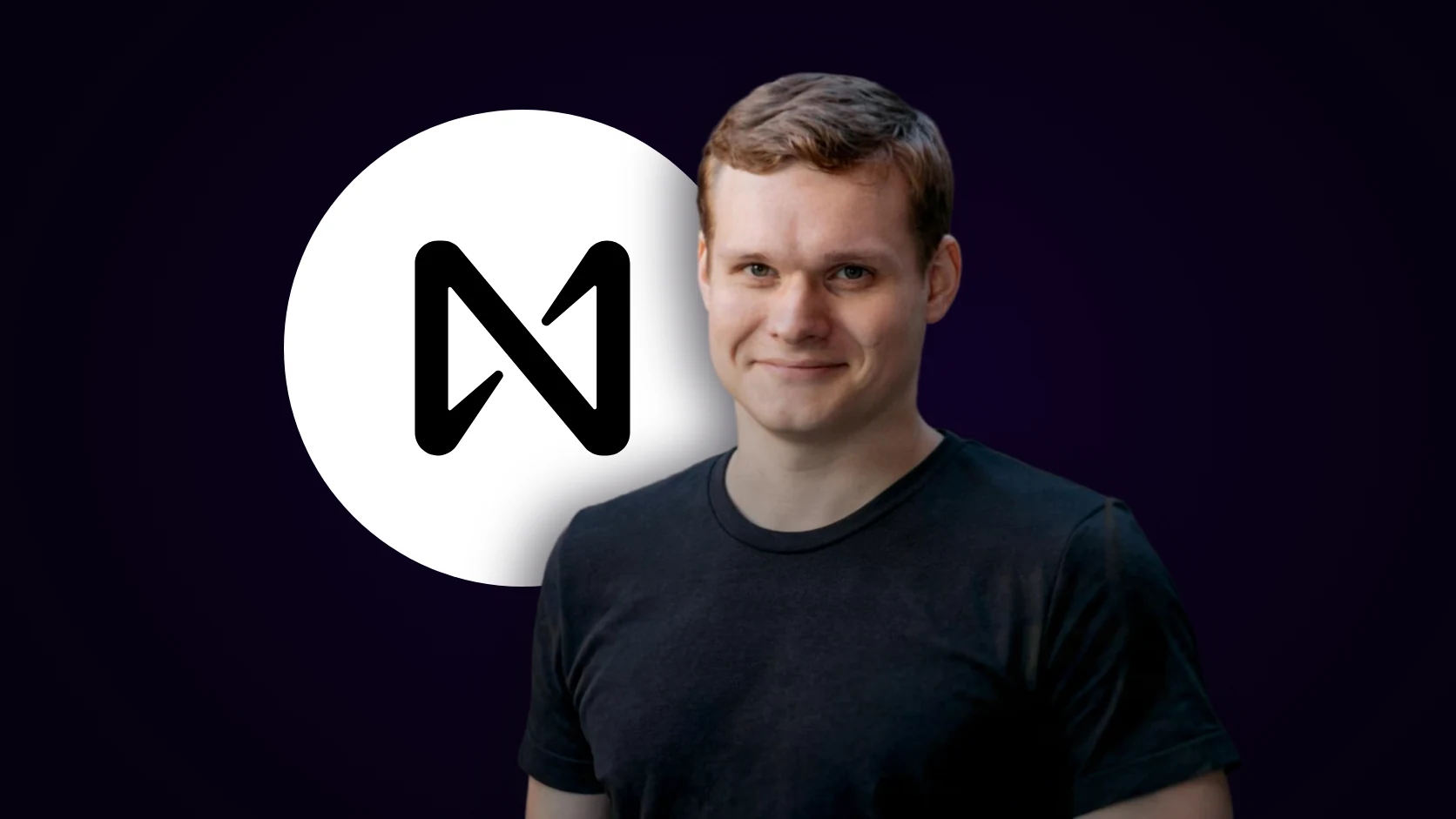
Illia Polosukhin is a Ukrainian-born software engineer who co-founded NEAR Protocol with Alexander Skidanov. Before moving into blockchain he spent nearly three years at Google Research, where in 2017 he co-authored "Attention Is All You Need", the paper that introduced the Transformer architecture behind today's generative AI. NEAR is a proof-of-stake network that splits its state across shards, a technique known as sharding, to process transactions in parallel.
His career answers one problem seen from two sides: how to coordinate the work and payments of people who share no bank, country or company. NEAR was born when an artificial intelligence project could not pay its contributors abroad, and his current bet on "user-owned AI" tries to bring that same infrastructure to AI agents. Separating Polosukhin from NEAR Protocol, the NEAR Foundation and NEAR AI helps show what each one decides.
Who is Illia Polosukhin?
Polosukhin is a co-founder of NEAR Protocol and the founder of NEAR AI, a research and product company building verifiable, privacy-preserving AI, according to its own website. On November 7, 2023, the NEAR Foundation, the Swiss non-profit that supports the ecosystem, named him chief executive; his predecessor, Chris Donovan, became chief operating officer, according to U.Today. In October 2026, The Block listed him on the foundation's council, the body that oversees its main decisions.
His co-founder, Alexander Skidanov, started at Microsoft in 2009 and was the first engineer at MemSQL, the distributed database now called SingleStore, where he became director of engineering, according to TechCrunch. The pairing explains the company's profile: Polosukhin brought machine learning research and Skidanov the distributed systems experience that a sharded network would later demand.
Education and career at Google
Polosukhin studied at the National Technical University Kharkiv Polytechnic Institute (KhPI), whose Department of Computer Mathematics and Data Analysis lists him among its alumni for the years 2008-2013. Public sources do not detail his degree or any jobs before Google. At Google Research, according to TechCrunch, he contributed to TensorFlow and managed the team building direct answers to questions typed into search, work that required models that were fast and cheap to run.
That requirement lies at the origin of his role in the Transformer. According to Wired's account of the eight authors, in 2016 Polosukhin told Jakob Uszkoreit that his models could not answer within the milliseconds search allows, and Uszkoreit suggested self-attention, a mechanism that relates every word in a sentence to every other instead of reading them one by one. The contribution note of the paper, posted to arXiv on June 12, 2017, credits Ashish Vaswani and Polosukhin with designing and implementing the first Transformer models.
Polosukhin left Google in early 2017, before publication, and was the first of the eight authors to leave, according to CNBC. In that interview he explains that a company of Google's size needs ideas big enough to justify a large launch, and that he wanted AI to be the product rather than an improvement inside another one.
From NEAR AI to NEAR Protocol
In 2017 Polosukhin and Skidanov founded NEAR AI with a specific goal: models that could write code from a natural language description. To train them they hired computer science students in several countries. NEAR's official history sums up what happened next: the models did not scale, there was not enough GPU capacity, and paying contributors across borders turned into a second problem, because some had no bank account and sending crypto in 2018 was expensive.
That second problem led them to study blockchain networks, and in 2018 they founded NEAR Protocol to build the network they would want to use as developers. NEAR itself admits they expected it to take six months. In May 2020 the company closed a $21.6 million round led by Andreessen Horowitz, according to TechCrunch, the same month it announced its mainnet.
Nightshade and the NEAR launch
NEAR's technical contribution lies in Nightshade, the sharding design Skidanov and Polosukhin published in July 2019. Instead of running an independent chain per shard, Nightshade produces a single chain in which each block is split into chunks, one per shard, and each validator only processes the state of its assigned shard. Version 2.0, updated in February 2024 with Bowen Wang as co-author, adds stateless validation: with each chunk the validator receives the part of the state it needs and a proof that it belongs to that state.
The launch was gradual. The genesis block was produced on April 22, 2020, in a phase in which only the foundation ran nodes and transfers were locked, according to NEAR's announcement. In September 2020 the foundation shut down its nodes and the network passed to independent validators, and on October 13, 2020, those validators voted with two thirds of the stake to enable transfers, according to CoinDesk.
The network presents itself as a layer 1 with human-readable accounts and native account abstraction, so the user does not handle a hexadecimal address. Since 2023 the foundation's strategy has turned to chain abstraction: signatures on other networks through multi-party computation, and NEAR Intents, a system in which the user states what they want to obtain and third parties compete to execute it.
Person, foundation, company and network
Four layers coexist at NEAR and are easy to confuse. NEAR Protocol is the network and its NEAR token, governed by the protocol rules and by the validators who accept each upgrade. The NEAR Foundation is a Swiss foundation that funds the ecosystem and manages its treasury, with a council that oversees its decisions. NEAR AI is a company with its own product, and Polosukhin appears as its founder. His roles in the foundation and in the design give him weight in the network's decisions, but a protocol change still depends on validators adopting it.
The bet on "user-owned AI"
On May 22, 2024, Polosukhin announced that NEAR would focus on user-owned AI, and the foundation created NEAR AI as a research lab co-led with Skidanov, according to Decrypt. The idea, in his words to CNBC, is AI that optimizes for the privacy and sovereignty of its users, as opposed to a future in which a few companies control the most capable models. Metlabs examines the concrete limits of combining networks and AI in AI and blockchain.
In February 2026 NEAR AI presented IronClaw, a runtime for AI agents that keeps credentials encrypted in a vault the model never sees, isolates each tool in a WebAssembly virtual machine and can run inside confidential enclaves. Polosukhin explained on Bankless that this trust rests on hardware from manufacturers such as Intel and NVIDIA, which attest to the software running inside the enclave.
Illia Polosukhin today
In an interview with The Block on October 7, 2026, Polosukhin argued that a large part of the activity that now goes through centralized platforms can already happen on-chain through near.com, with tokenized stocks via Ondo Finance since September and confidential transactions the user can selectively disclose. The same piece reports that, less than a week earlier, NEAR Intents suffered an exploit of about $3.8 million; the bug was fixed and the funds were returned.
What is Illia Polosukhin's net worth?
There is no reliable estimate of Illia Polosukhin's net worth. As of November 10, 2026, neither Forbes nor the Bloomberg Billionaires Index publishes a figure for him, and Polosukhin has not disclosed his holdings. The amounts circulating online come from aggregator sites that do not explain their method, so this profile does not reproduce them.
What is public are the sources that wealth would depend on. As a NEAR co-founder he took part in the token's initial distribution, but there is no record of how much NEAR he holds; NEAR AI is a private company with no published valuation, and the NEAR Foundation does not publish its executives' pay. Wired put NEAR's market capitalization at around $4 billion in 2024, a figure that measures the token's market value and changes daily, not the share Polosukhin owns.
Illia Polosukhin's contribution: treating the network as a developer product
Polosukhin's contribution lies in treating a blockchain network as a product that had to solve a concrete operational problem, paying and coordinating people spread around the world, rather than as a cryptographic experiment. Nightshade and the phased launch, with transfers enabled only once independent validators voted for them, show that way of working: a published design, gradual deployment and control handed to third parties. His name on the Transformer paper also gives him credibility in AI backed by a document anyone can check.
The limit lies in his current bet. User-owned AI promises privacy and control, but IronClaw and NEAR AI Cloud rest that guarantee on hardware enclaves from large manufacturers, and the October 2026 exploit of NEAR Intents is a reminder that adding layers of abstraction also adds points of failure. Whether user-owned AI becomes more than a good design will depend on those guarantees being verifiable outside NEAR itself.

- arXiv: Attention Is All You Need (12 Jun 2017)
- Wired: 8 Google Employees Invented Modern AI (20 Mar 2024)
- CNBC: Illia Polosukhin, one of Google's Transformer 8 (27 Jun 2024)
- NTU KhPI: alumni profile of Illia Polosukhin
- NEAR: roadmap and history
- TechCrunch: NEAR raises $21.6M from a16z (4 May 2020)
- NEAR: Nightshade sharding design 2.0 (Jul 2019, updated Feb 2024)
- NEAR: MainNet genesis announcement (4 May 2020)
- NEAR: MainNet is now community-operated (24 Sep 2020)
- CoinDesk: validator vote moves NEAR to Phase II (13 Oct 2020)
- U.Today: Illia Polosukhin named NEAR Foundation CEO (7 Nov 2023)
- Decrypt: NEAR launches user-owned AI lab (22 May 2024)
- NEAR AI: company page
- Bankless: Illia Polosukhin on IronClaw (24 Mar 2026)
- The Block: Polosukhin on centralized exchanges and near.com (7 Oct 2026)
- The Block: NEAR Foundation Council appointment (15 Oct 2026)
Got a blockchain project in mind?
From idea to product, strategy and technology must move forward together.