Who Is Anatoly Yakovenko, the Founder of Solana?
Who is Anatoly Yakovenko, how his Qualcomm engineering background led to Proof of History, and the team that turned Solana into a live network.
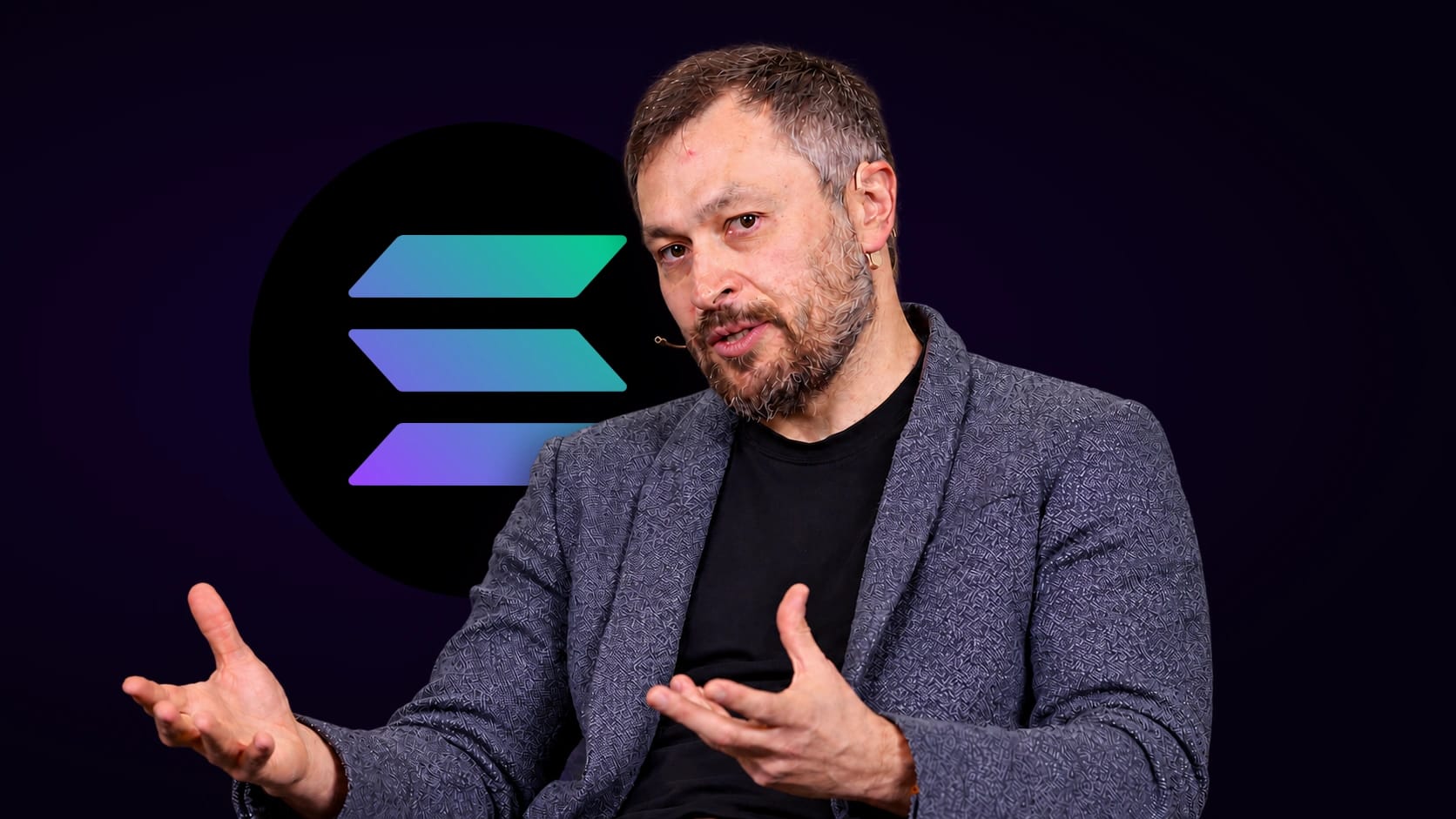
Anatoly Yakovenko is a cofounder of Solana, a blockchain network designed to coordinate many computers with as little delay as possible. He previously worked on systems where a few milliseconds and a few network messages could change the performance of the entire product. That experience helps explain why coordinating time became central to his proposal.
The ingenuity of that proposal lies in giving architectural weight to an apparently small question: how computers agree on time. The path from Qualcomm to Proof of History allows that idea to be examined while recognizing the cofounders and teams who brought it into an operating network.
Who is Anatoly Yakovenko?
Anatoly Yakovenko is the systems engineer who drafted the original architecture for Solana and one of its four co-founders. His defining contribution was Proof of History, a cryptographic sequence that lets participants verify the order and passage of time between events. The proposal addressed a specific coordination problem in distributed networks.
The Solana Foundation records that he previously led operating systems work at Qualcomm, distributed systems at Mesosphere, and compression at Dropbox. He was also a core kernel developer for BREW, software that powered more than 100 million CDMA phones. That experience in operating and distributed systems helps explain Solana’s design priorities.
What did Yakovenko do before founding Solana?
He spent 13 years at Qualcomm working close to hardware, mobile operating systems, and wireless communications. He moved to Mesosphere in 2016 and Dropbox in 2017, remaining focused on distributed infrastructure, compression, and performance. Two patents for high-performance operating system protocols also came out of that broader period.
That background reframed the problem. Instead of assuming every blockchain network had to coordinate like earlier public ledgers, Yakovenko asked which techniques from communications systems could remove messages from the critical path. He approached consensus as coordination among computers before approaching it as a monetary system.
How did Proof of History begin?
In October 2017, Yakovenko considered using SHA-256, the hash function familiar from Bitcoin, as a deliberately sequential process. Each output becomes the next input. Producing that chain takes time, while separate segments can be checked in parallel. The result is a verifiable clock that establishes whether one event occurred before another.
Proof of History does not replace Proof of Stake and is not a consensus mechanism on its own. The Solana whitepaper presents it as a way to order events and reduce messages between machines. In the original architecture, Tower BFT combined that clock with validators’ stake-weighted votes. This explains the founding design without implying that every original component must remain in the protocol forever.
Solana's performance comes from connected design choices. Proof of History orders events, Sealevel schedules non-conflicting transactions in parallel, Turbine propagates blocks, and Gulf Stream forwards transactions toward upcoming leaders. Treating the clock as a stand-alone speed switch misses the system Yakovenko and the early team actually built.
Who co-founded Solana with Yakovenko?
Four co-founders brought complementary skills to Solana. Calling Yakovenko the sole creator removes the engineering and operating work required to turn a technical paper into open-source software, a company, and a validator ecosystem.
- Anatoly Yakovenko proposed Proof of History and the initial architecture.
- Greg Fitzgerald moved the prototype from C to Rust and published the first open implementation in February 2018.
- Stephen Akridge proposed using GPUs to verify signatures in parallel.
- Raj Gokal joined in December 2017 to build the organization and develop its market.
The company first used the name Loom. To avoid confusion with Loom Network, the founders renamed it after Solana Beach in California, where Yakovenko, Fitzgerald, and Akridge had surfed while working at Qualcomm in San Diego.
When did Solana become a live public network?
The first open prototype appeared in February 2018, and Mainnet Beta launched on March 16, 2020. More than two years of validator testing separated those milestones. Rust became the main client language and now underpins much of the network's application development through Solana programs built with Anchor.
Processing capacity comes with tradeoffs. Demanding hardware can raise the barrier to running a validator, while parallel execution makes account access part of application design. Choosing an architecture for Solana requires assessing security, recovery from faults and behavior under load alongside advertised speed. The Mainnet Beta launch label alone cannot establish those properties.
Does Anatoly Yakovenko own Solana?
No. Yakovenko co-founded Solana Labs and retains substantial technical and public influence, but he cannot unilaterally own or change the network. Validators run the software, vote on blocks, and choose which releases to adopt. The independent Solana Foundation supports protocol decentralization, security, and adoption.
Open access does not eliminate concentration. The June 2025 network health report documented substantial dependence on the Agave client family. Firedancer represents an independent effort to diversify software. That report is a dated snapshot, not a current measurement: decentralization needs to be examined across operators, stake distribution, clients and the ability to influence protocol changes.
What is Yakovenko's technical legacy?
His lasting contribution is showing that a public network can be designed from high-performance systems principles. Solana chose to retain shared global state and expand capacity on one layer instead of fragmenting execution from the outset. That supports synchronous composability, but it also demands capable machines and operational discipline.
For a development team, that architecture changes product engineering. EVM patterns cannot simply be copied over to Solana. Its account model and parallel execution require deciding which data each instruction reads or modifies and where conflicts can occur. Performance depends on those choices, not just on a final optimization pass.
A useful assessment therefore goes beyond laboratory throughput. It asks whether applications remain responsive under contention, how validators recover from faults and whether independently developed clients reduce shared software risks. Reliability belongs in the performance discussion; a fast benchmark does not establish the quality of a production network.
The evolution does not end with Proof of History. The Alpenglow proposal sets out a replacement for components of the original consensus design. Proposal, approval and activation are separate milestones: a roadmap must not be described as an already deployed capability. It also shows that several teams contribute to Solana’s evolution, beyond Yakovenko.
If you need to turn that architecture into a production product, our blockchain development team designs, tests, and deploys the required infrastructure.

- Solana Foundation, Anatoly Yakovenko’s engineering background
- Solana technical whitepaper
- Solana, Proof of History explained (2018)
- Solana, early history
- Solana, Mainnet Beta launch (2020)
- Solana Foundation, June 2025 network health report (2025)
- Solana Foundation, mission and governance
- SIMD-0326: Alpenglow consensus proposal
Got a blockchain project in mind?
From idea to product, strategy and technology must move forward together.