Blockchain in healthcare: applications, privacy and limitations
How to assess shared healthcare registers, traceability and evidence without confusing integrity with privacy or clinical quality.
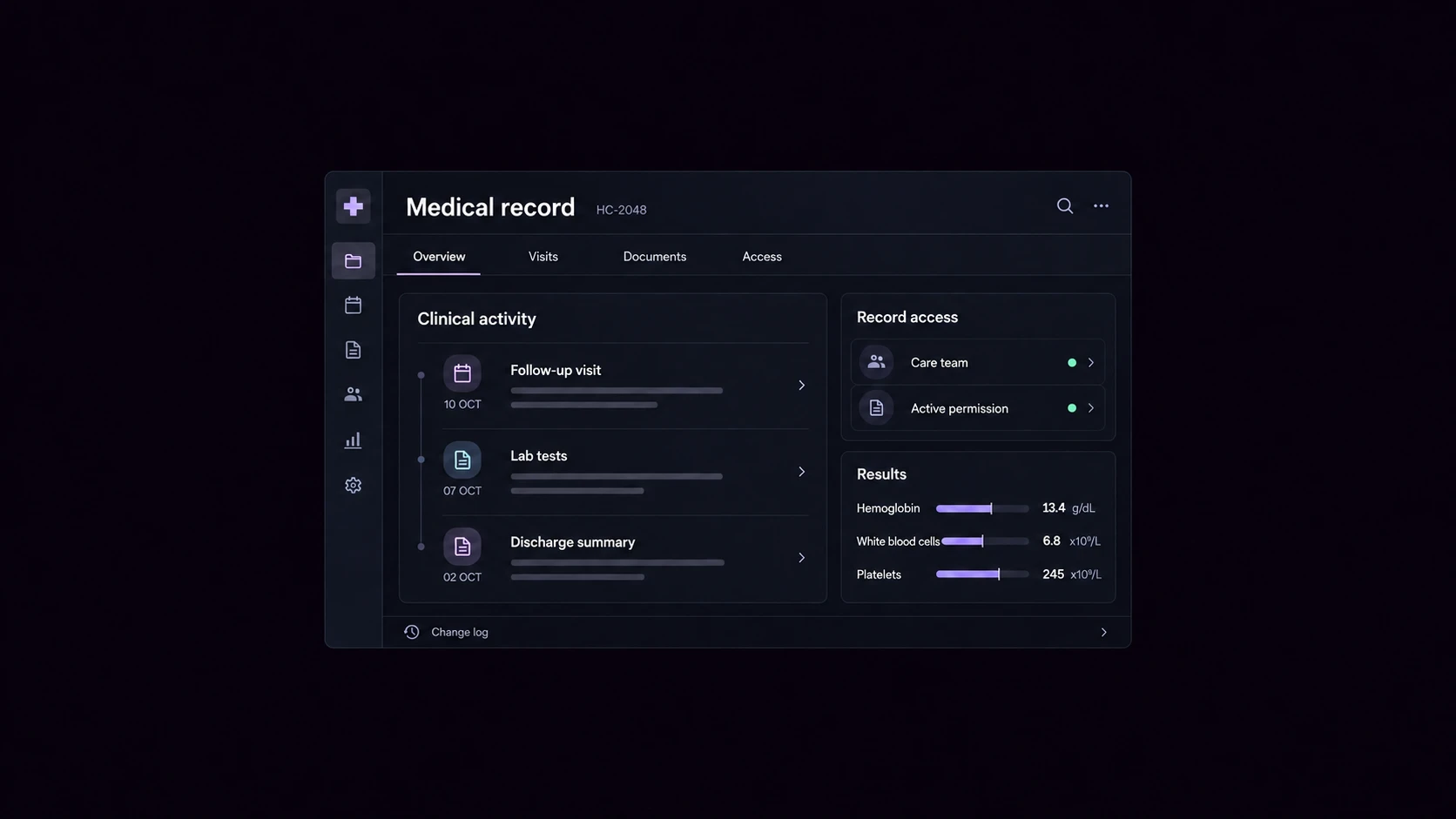
Healthcare and medicine supply involve organizations that need to exchange reliable information. A hospital may need to verify where a record originated, while a distributor needs to trace a product’s journey. Blockchain offers a way to share evidence about those processes.
Applying it in healthcare requires deciding what information is recorded and who can access it. That distinction makes it possible to examine traceability without assuming that clinical data belongs on a blockchain. Patient confidentiality and each organization’s responsibilities are part of the design from the outset.
What problem it may solve
A healthcare system may need to share evidence of authorisations, provenance or document versions between organisations. A distributed register is one possible architecture when those parties need to verify a shared history. It does not improve clinical data quality by itself or make every access secure.
Start by defining who writes, what others verify and which responsibilities each organisation retains. An access-controlled database with audit logs may solve the same problem with less complexity.
Clinical data and privacy
Patient records, diagnoses and identifiers should not be published on a public network. Hashes are not automatically anonymous: auxiliary information may allow records to be linked. Encrypting information does not guarantee it ceases to be personal data.
The EDPB guidelines on blockchain and personal data support assessment of responsibilities, retention and rights. Before designing the register, define the legal basis, access, rectification, erasure and risk assessment. Architecture must support applicable obligations throughout its lifetime.
Applications worth evaluating
Evidence of versions and authorisations
A register can retain references to versions and authorisation events while documents remain in controlled clinical systems. Evidence establishes what was recorded, not whether a diagnosis was correct. Revocations and corrections must remain operational off-chain.
Medicine traceability
Sharing signed events between manufacturers, distributors and dispensers can support provenance checks. Operators still need to link an identifier to a physical product and detect false records. The FDA explains its drug traceability requirements; using blockchain alone does not demonstrate compliance.
Research documentation
Anchoring references to study protocols or versions can help detect later changes. It does not validate results, participant consent or trial quality. Original documents and their context must be retained.
Design example: sharing a protocol version
Suppose several organisations participate in a study and need to establish which protocol version was current. One possible architecture keeps documents in controlled repositories and records references to approved versions. That purpose does not require publishing clinical records.
The workflow should identify who approves a version, who may consult it and how replacement is indicated. When an error is found, preserving history does not mean continuing to present the incorrect document as current. The application needs to show the relationship between the earlier version and its correction, with defined permissions and responsibilities.
This is an architectural example, not clinical validation or an established compliance solution. Before implementation, assess whether references can identify people and how applicable rights will be respected. Technical trials can use synthetic documentation to evaluate the workflow without introducing patient data.
Pilot acceptance should establish that each organisation retrieves the right version, unauthorised actors cannot declare one current and register downtime does not prevent access to necessary documentation. Measuring these properties is more informative than counting written transactions.
Evaluating a pilot
Define a measurable hypothesis: reconciliation time, identification errors or availability of evidence. Test access revocation, lost keys, unavailable participants and recovery. Compare with a conventional solution and describe findings as a pilot until there is evidence of real operations.
Value comes from a better process and clear responsibilities, rather than promises of tamper-proof data or guaranteed privacy.
Got a blockchain project in mind?
From idea to product, strategy and technology must move forward together.