Provider guide
Real estate tokenization companies and platforms
Metlabs and international real estate tokenization references: scope, integrations and criteria for choosing a platform for your project.
A business planning to tokenize real estate needs to coordinate the rights offered to investors, capital raising and the platform used to administer the issuance. Development companies, infrastructure providers and marketplaces for property interests can all be involved. Their services are related, but they address different needs.
This guide brings together Metlabs and three international references with public documentation: DigiShares, Tokeny and Lofty. The selection helps distinguish services for launching your own project from platforms for investing in existing offerings. Metlabs publishes this page and provides real estate tokenization services; this is a commercial selection, not an independent or exhaustive ranking.
What to compare when choosing a real estate tokenization company
Start with the role your business will play. A developer seeking to finance a property project needs a solution for issuing and managing that project. An investor seeking exposure to real estate needs to assess a platform’s offerings and their terms. Treating these services as interchangeable can lead to choosing a product that does not meet the brief.
- Scope: what the provider includes at launch and what the issuer must arrange separately.
- Integrations: how identity, signatures, payments, custody and property administration connect.
- Operations: who handles incidents, maintains holder records and prepares distributions and reports.
- Responsibilities: what belongs to the issuer, legal counsel and any entities providing the regulated services the project requires.
 Metlabs: a tokenization platform for your real estate project
Metlabs is a blockchain development studio based in A Coruña, Spain. Our in-house technical team connects product definition, architecture, smart contracts, backend and interface development. We work on the application and its business integrations; the proposal identifies the components, people and responsibilities required for the chosen network.
For tokenized issuances in Spain, we have published our collaboration agreements with Onyze for custody integration and Ursus-3 Capital for coordination with securities registration. These agreements describe how our software work connects to the other participants in an issuance. The responsibilities and providers needed for your project are defined in its own scope.
Product decisions and integration scope
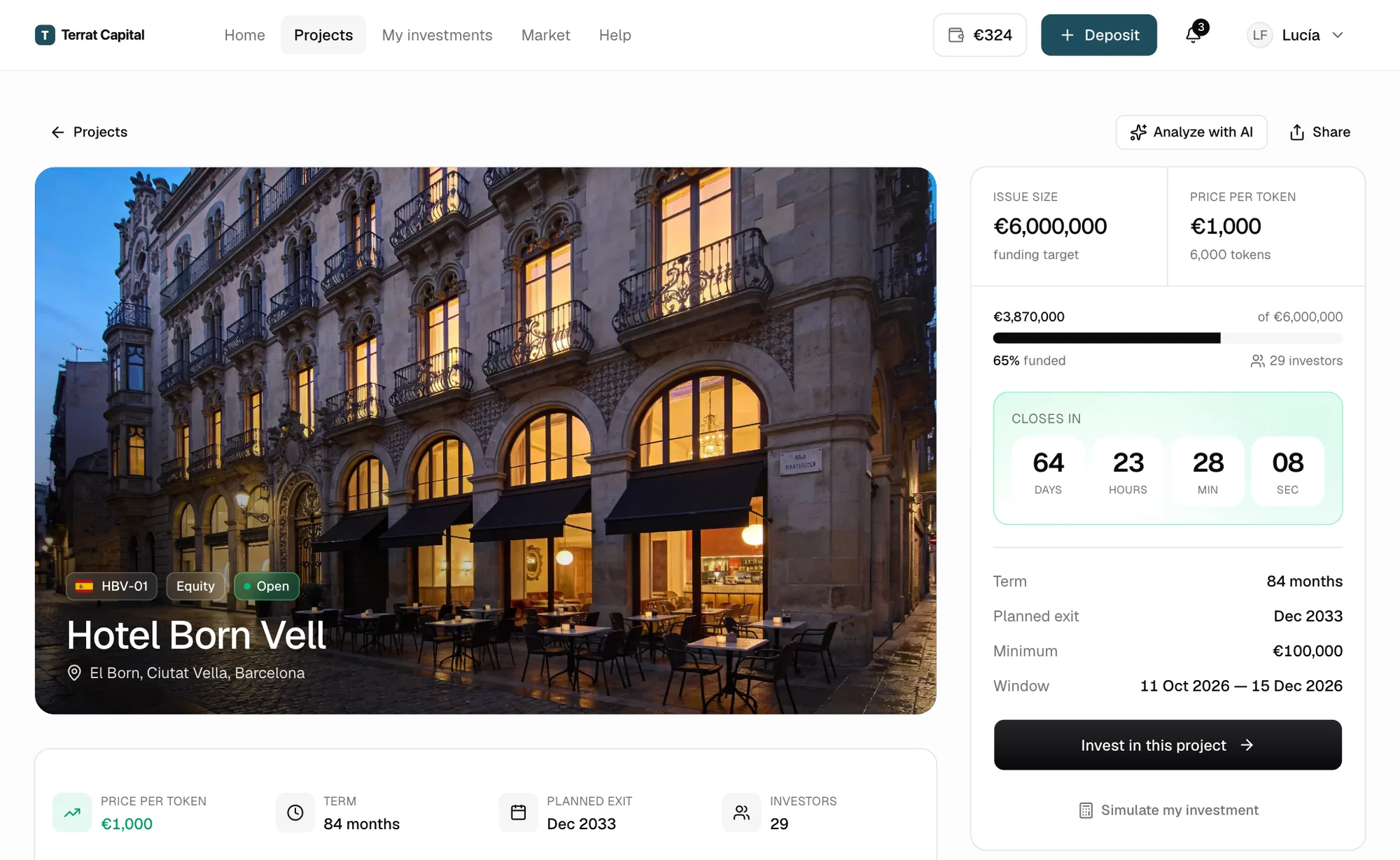
At Metlabs, we develop the platform an issuer uses to present projects, onboard investors and administer operations under its own brand. The work connects the investor portal, tokens and management console to the requirements of the issuance. Our real estate tokenization platform describes the scope.
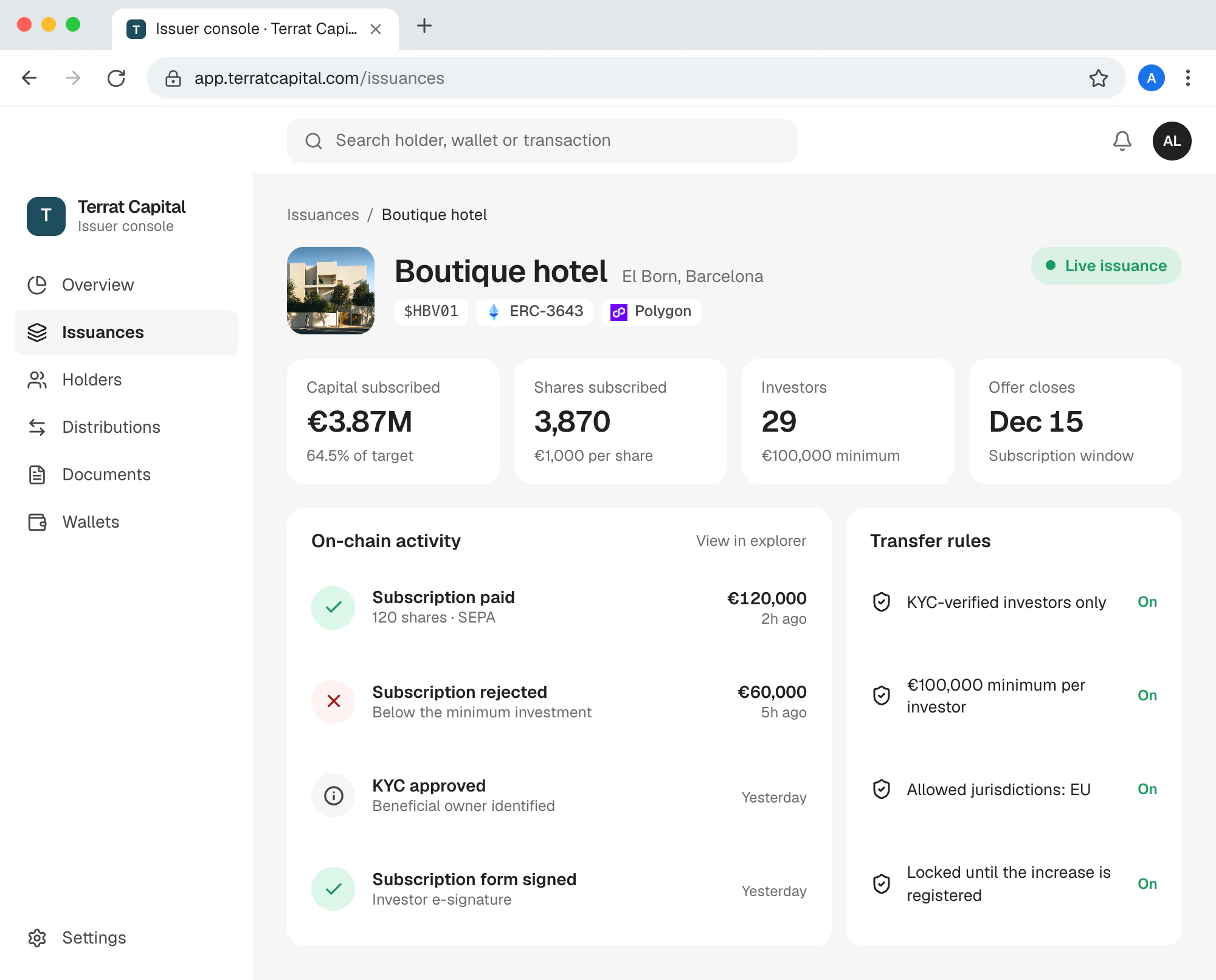
The journey includes registration and identity verification, electronic signatures, SEPA or stablecoin payments, ERC-3643 tokens and distribution management. Transfer rules are configured around the offering requirements; holder voting and connections to property management are developed according to the agreed scope.
Our role is to build and maintain that infrastructure, coordinating its requirements with the legal firm structuring the issuance and with any custody or regulated service providers the project needs. Software development does not replace those functions or guarantee capital raising or buyers for a future transfer.
To assess our proposal, review a demonstration of the complete journey: from property documentation and investor onboarding to subscription, recordkeeping and a distribution. This allows you to check the workflow against the business model, integrations and intended responsibilities.
What to include in the Metlabs proposal
- An investor journey with property documentation, identity verification, signing and the agreed payment methods.
- An issuer console for tracking subscriptions, holders, transfer rules and distributions.
- Integrations with legal counsel and the identity, custody or payment providers required by the offering structure.
- Reconciliation, permission and incident handling tests, with documentation for the issuer’s team.
The work follows the phases described in our blockchain development service: discovery, architecture and design, iterative development, and validation before release. We agree on the first journey to build and its acceptance criteria at the start, so progress can be checked against a working delivery. External audits, specialist integrations and ongoing support are scoped in the proposal.
To discuss the scope with Metlabs, share the asset or process, its users, existing systems and the operations the first release must support. This gives the team a basis for identifying dependencies and preparing a proposal you can compare with the other providers in this guide.
 DigiShares: issuance and investor administration software
DigiShares offers software for developers, managers and asset owners issuing and administering tokenized assets. Its documentation includes holder records, agreement signing, distributions and integrations. It states that it provides B2B software and does not act as an investment intermediary or process payments.
When reviewing a proposal, ask which functions are included, which connections are needed and what support is planned for your operation. A feature’s presence in a product catalogue does not by itself establish how it connects to your providers or the terms of your agreement.
 Tokeny: infrastructure for issuing and managing tokenized securities
Tokeny, based in Luxembourg, presents solutions for investor onboarding, token issuance and post-issuance administration. Its technical documentation describes integration APIs and T-REX, an implementation of the ERC-3643 standard for permissioned tokens.
It is a reference for examining how the issuance layer connects to other systems. For a specific proposal, establish who builds the investor experience, who maintains each integration and which operational functions belong to each participant. Those responsibilities should be part of the contracted scope.
 Lofty: a marketplace for property interests in the United States
Lofty presents a fractional investment marketplace for US properties. Its website allows users to browse properties and describes purchasing interests, income distributions and order management. It is included as an example of an investor-facing product, rather than an equivalent alternative to commissioning an issuer’s platform.
If your objective is to invest, compare each offering’s documentation, expenses, acquired rights and transfer terms. If you want to launch your own issuance, first establish what service a platform would provide and what work would remain with your business.
How to compare proposals for your property project
Prepare the same brief for providers that fit: property type, issuance jurisdiction, intended investors, the rights they will receive and the systems your business already uses. This gives you a basis for comparing deliverables and responsibilities rather than isolated feature lists.
- Request a demonstration of your operational steps: identification, signing, payment, issuance, position reporting and distribution.
- Separate setup, integrations and recurring operations. Identify third-party costs and the conditions under which they may change.
- Check permissions over contracts and keys, data exports, recovery and the process for changing providers.
- Request authorized references and audit reports identifying their scope and version. A technical report does not establish the soundness of the entire operation.
A suitable proposal should explain how your issuance works and who is responsible for each part throughout its life. To explore working with Metlabs, tell us about your project so we can review the asset, operations and integrations before defining the scope.
Got a blockchain project in mind?
From idea to product, strategy and technology must move forward together.