Proof of Work vs Proof of Stake: key differences
PoW and PoS compared through Bitcoin and Ethereum: validation, finality, energy, attacks and criteria for evaluating a blockchain.
A blockchain network needs rules for adding new blocks and maintaining a history its participants can verify. Proof of Work and Proof of Stake are two ways of organizing participation in that process. The former uses computational work; the latter uses committed capital and rules for selection and voting.
Bitcoin and Ethereum show how these mechanisms operate in specific networks. Bitcoin uses proof of work, while Ethereum moved to proof of stake with The Merge on September 15, 2022. Comparing them requires understanding block proposal and validation, transaction finality and the behaviors each system can penalize.
What consensus does
Nodes need to agree on history while receiving different operations at different times. Validity rules determine acceptable transactions and blocks. Consensus helps coordinate which valid history prevails and when it becomes stable.
Proposing a block does not authorise inventing balances or spending without a valid signature. Other nodes check the rules. Controlling participation resources differs from controlling the entire protocol.
Proof of Work in Bitcoin
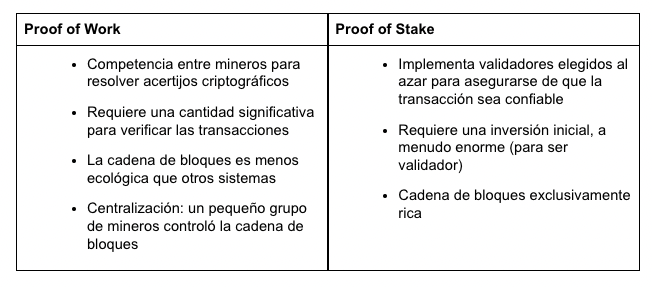
Miners construct block headers and try variations until a hash meets the difficulty target. More hashing capacity increases the probability of finding a valid proof. Participants do not receive individual puzzles or identical chances.
Nodes verify both the proof and block contents. Among valid chains, accumulated work helps determine the accepted history. Producing work is costly; checking a particular proof requires much less computation.
Miner rewards include issuance subsidy and transaction fees. A halving reduces the subsidy, not necessarily the total reward. Our halving guide explains the distinction and block-height rules.
Difficulty adjusts the threshold a hash must meet. It does not turn mining into solving increasingly sophisticated mathematical problems. The search remains repetitive; the expected number of attempts changes.
Energy and mining concentration
PoW involves continuing work competition and electricity consumption. Environmental impact depends on consumption, energy sources, equipment and estimation methodology. An illustration of solar panels does not establish mining’s overall energy mix.

Open participation does not mean equal economic conditions. Hardware, energy access, financing and mining pools influence work distribution. A pool coordinates participants; its hash share does not automatically mean ownership of their equipment, although coordination can concentrate decisions.
Proof of Stake in Ethereum
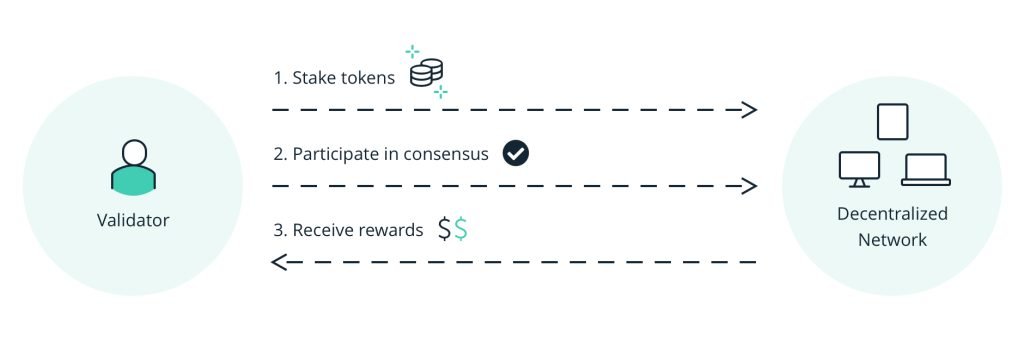
Ethereum validators commit ETH and perform proposal and attestation duties under protocol rules. Rewards and penalties depend on those duties. Stake supplies economic weight; simply holding ETH in a wallet does not make its owner a validator.
Ethereum combines fork choice with vote-based finality. Required thresholds enable checkpoint finalisation. Describing all PoS as “the richest participant wins” is inaccurate, as is assuming identical selection and penalty rules across networks.
Slashing applies to identifiable signing violations, including particular contradictory proposals or votes. Being offline is not itself a slashing offence: inactivity penalties and specific recovery mechanisms apply when finality cannot be reached. Duplicate keys or misconfigured software can cause harm without malicious intent.
Understanding finality
Bitcoin confirmations add work above a block, supporting assessment of resistance to reorganising that history. No universal confirmation count suits every value or network condition.
In Ethereum, inclusion and finalisation are different states. Finality requires a stake supermajority; sufficient absent or adversarial participation can prevent it. Applications should distinguish inclusion, confirmation under their own policy and protocol finality.
An interface displaying “complete” after receiving a transaction hash skips those stages. The mechanism determines what evidence a product needs before delivering goods, recognising payment or enabling withdrawal.
Why 51% does not describe every attack
In PoW, a sustained hash majority can facilitate censorship and reorganisations, including double spending an attacker’s own transactions. It cannot forge another user’s signature or force independently validating nodes to accept arbitrary invalid blocks.
In PoS, thresholds depend on the attack and design. Delaying finality, censoring and producing conflicting finalised states are different problems. Ethereum documentation distinguishes those capabilities and potential responses. PoS neither eliminates every majority attack nor establishes a universal comparison of attack cost across networks.
Energy, throughput and governance differ
Ethereum.org estimates that The Merge reduced Ethereum’s electricity consumption by about 99.95%. This compares that network before and after its transition; it is not a universal reduction for every transaction or the entire industry.
Replacing proof-of-work mining does not automatically multiply execution capacity. Throughput and fees also depend on block limits, hardware, propagation and demand. The Merge was not designed as a direct gas-fee reduction.
Governance cannot be inferred from PoW or PoS either. Ethereum coordinates proposals and software adoption off-chain, rather than holding a general ETH-holder ballot for every upgrade. Other networks use different mechanisms.
Apply the comparison to a project
Assess a specific network’s finality, operator distribution, client diversity, costs and failure response. Then examine application dependencies: RPC, oracles, bridges and permissions. Sound consensus cannot repair a defective contract.
Express the decision through observable requirements, such as the state required to recognise payment and behaviour when finality is delayed. This is more useful than selecting technology through generic advantages.
Got a blockchain project in mind?
From idea to product, strategy and technology must move forward together.