


Executive Summary
Solidity is a programming language designed specifically for the development of smart contracts on blockchains compatible with the Ethereum Virtual Machine (EVM), and stands out as the cornerstone for developing dapps (decentralized applications). In this post we will explore its essence, its connection with EVM networks, and how this language has triggered a new era of smart contracts, transforming the way we conceive and execute agreements in the decentralized landscape.
Introduction to Solidity
Solidity has become the most common entry point for building smart contracts on EVM-compatible networks, and that is why understanding it well makes the difference between an experiment and a deployable product. Throughout this post you will see where the language comes from, how it fits with the Ethereum Virtual Machine, and what it really means for code to execute on a public blockchain. This is not just about learning syntax, it is about understanding how rules, permissions, and states are defined and then recorded and executed deterministically. When you internalize that logic, you start making better design decisions, especially around security, execution costs, and clarity for audits.
Origins of Solidity
The birth of Solidity dates back to the early days of Ethereum in 2014. Its genesis is attributed to Gavin Wood, a key programmer on the founding Ethereum team. At that time, the growing popularity of cryptocurrencies and decentralization raised a fundamental question: how could we translate complex agreements and transactions into executable code on the blockchain? That need opened the door to a new approach, where rules are written once and executed consistently for all participants.
Gavin Wood, recognizing this critical need, set out to create a programming language that could address the specific challenges of smart contracts. Thus Solidity was born, designed from its foundations to facilitate the programming of business rules in a secure and efficient way. The idea was that the contract would not depend on human interpretations or intermediaries, but on programmable logic that executes with transparency within the ecosystem. This marked a before and after in the way digital agreements were conceived.
In its early stages, Solidity focused on providing developers with a familiar syntax, inspired by languages such as JavaScript and C++, to ease the transition and accelerate adoption. The vision was clear: allow anyone with programming knowledge to participate in the smart contract revolution. That familiarity lowered the barrier to entry and accelerated the emergence of prototypes and early dapps. Even so, the blockchain environment required learning new priorities such as state control and execution cost.
As Ethereum consolidated itself as one of the leading blockchain platforms, Solidity became essential to its ecosystem. Its evolution did not stop, and contributions from the community and development team ensured the language adapted to the changing demands and challenges of the blockchain space. Over time, the language gained robustness and integrated better with tools, libraries, and standards that simplified development. That maturity made building on EVM networks increasingly predictable and scalable.
Today, Solidity is not just a programming language, it is the backbone of countless decentralized applications dApps and smart contracts that drive interoperability and trust on the blockchain. From its modest origins to its central role in the blockchain landscape, Solidity remains a testament to the constant drive toward innovation and accessibility in the world of smart contract programming. Its adoption is explained by the fact that it allows moving from a business idea to executable logic with clear rules. That is why it remains the most common starting point when looking to build real solutions in this ecosystem.
Solidity and the Ethereum Virtual Machine (EVM): Exploring the Fundamental Symbiosis
Solidity, created by Gavin Wood in 2014, is not just a programming language, it is the catalyst that links Ethereum’s ambitions with the execution of smart contracts. Its history is intrinsically intertwined with the Ethereum Virtual Machine (EVM), the virtual machine that executes these contracts on the Ethereum blockchain.
The connection between Solidity and EVM is crucial for understanding how smart contracts take shape and come to life on the network. The Ethereum Virtual Machine acts as the execution engine, interpreting and carrying out the code written in Solidity. This symbiotic relationship is what allows developers to create business rules, programmable logic, and automated agreements in a secure and reliable way.
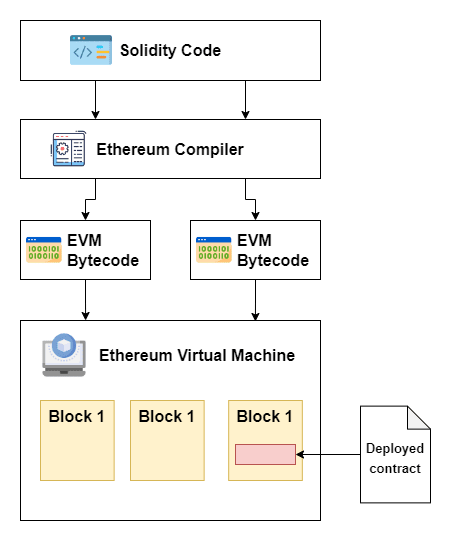
EVM is essentially a Turing-complete virtual machine that executes smart contracts using bytecode. Solidity, on the other hand, acts as the linguistic bridge between developers and this virtual machine. Contracts written in Solidity are compiled into bytecode that the EVM can understand and execute. This abstraction allows even those without deep knowledge of EVM internals to participate in the creation of smart contracts.
The Solidity-EVM relationship has proven to be the foundation of the smart contract revolution on Ethereum. It enables the reliable and decentralized execution of agreements, eliminating the need for intermediaries and providing transparency to transactions. Thus, Solidity not only simplifies the development of smart contracts, but also opens the doors to a new paradigm of trust and efficiency in the blockchain space.
How to Start Programming in Solidity
If you are intrigued by the idea of programming smart contracts and entering the decentralized world with Solidity, here is a basic step-by-step guide to take your first practical steps in smart contract development. At Metlabs we specialize in smart contract and dapp development with Solidity, get in touch with no commitment and get your blockchain project started. The fastest way to progress is to internalize a simple flow: write a small contract, compile it, and see how it behaves when executing functions, because that is where you understand the shift in mindset compared to programming traditional applications.
You can start programming your first Smart Contract with Remix. Through this online platform, accessible directly from your browser, it provides an intuitive development environment and allows you to write, compile, and deploy smart contracts efficiently. Remix reduces friction at the start, letting you test ideas without setting up a local environment, and helps you visualize the result of compilation and deployment immediately. That accelerates learning and makes it easier to detect failures before moving on to more complex scenarios.
Remix and Its Key Features
Open Remix directly from your browser and you will be ready to bring your smart contracts to life. Remix provides a set of tools aligned with the real process: first you write the contract, then you compile it with a specific version of Solidity, and finally you deploy it to verify that the state changes as expected. Repeating that sequence with small contracts builds a solid foundation for understanding gas, storage, and external calls, which are points that directly impact cost and security.
Integrated Editor
A development environment with a robust code editor that allows you to write, edit, and test your code directly on the platform, which accelerates iteration and reduces configuration errors. It also makes it easier to keep the code organized while experimenting with functions, state variables, and events.
Simple Compilation and Deployment
Remix offers integrated tools to compile and deploy your contracts efficiently, allowing you to focus on your contract’s logic rather than worrying about implementation details. This is especially useful at the start, because it lets you test quick changes and validate behavior without losing time on external adjustments.
Testing Environment
You can test your smart contracts directly in Remix using the integrated execution environment, which makes it easier to identify and correct potential issues. It also helps you observe how interactions are recorded, which functions consume the most gas, and how the contract responds to different inputs, something key for writing more robust contracts.
Basic Smart Contract Example in Solidity: An Initial Overview
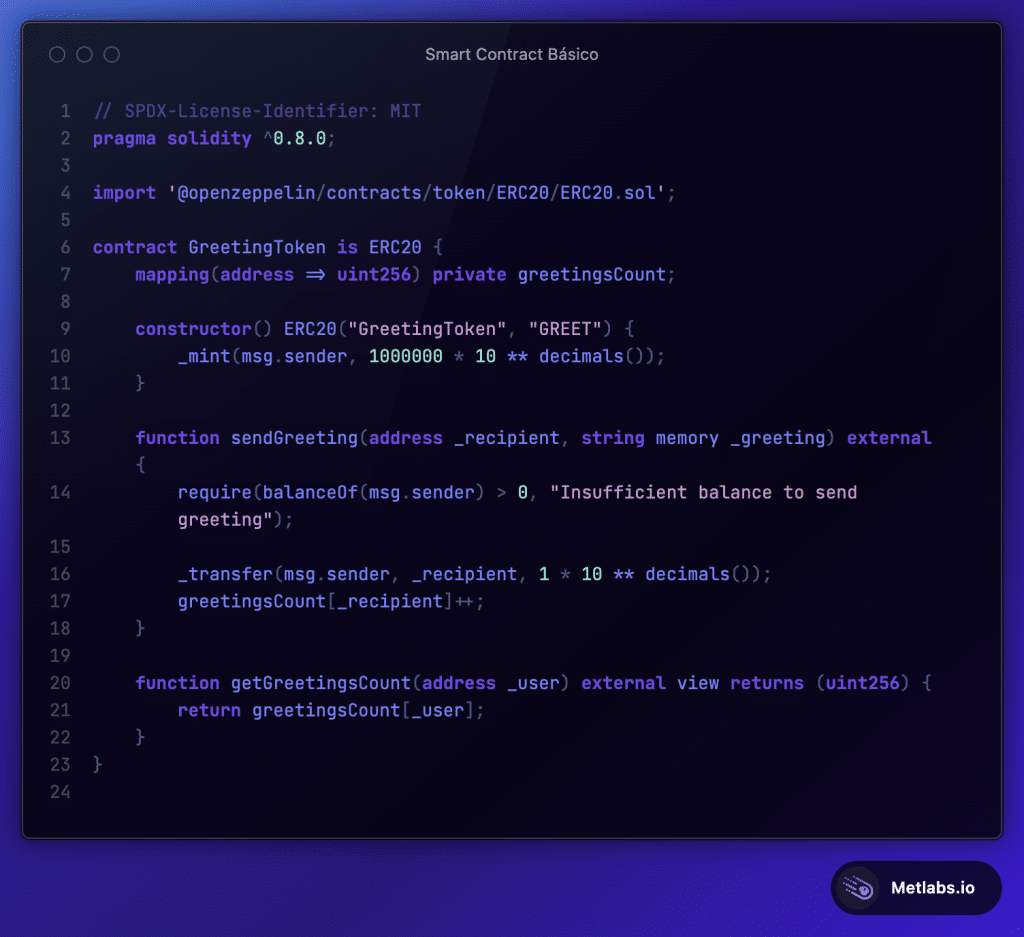
In this example, we will create a more advanced contract that represents a greeting token. This contract will allow users to send personalized greetings and count how many greetings they have sent. In addition, we will incorporate the OpenZeppelin library to ensure the security of the contract.
- OpenZeppelin Import:
import "@openzeppelin/contracts/token/ERC20/ERC20.sol";: Imports the OpenZeppelin library to use ERC20 functionality, which is the standard for tokens on Ethereum.
- Contract Declaration:
contract GreetingToken is ERC20 { ... }: Declares theGreetingTokencontract which inherits ERC20 functionalities.
- Greetings Sent Mapping:
mapping(address => uint256) private greetingsCount;: Creates a private mapping to keep track of how many greetings each user has sent.
- Contract Constructor:
constructor() ERC20("GreetingToken", "GREET") { ... }: Initializes the contract upon deployment, minting 1,000,000 tokens with the name “GreetingToken” and symbol “GREET”.
sendGreetingFunction:function sendGreeting(address _recipient, string memory _greeting) external { ... }: Allows users to send personalized greetings. Requires a sufficient balance and transfers 1 token to the recipient.
getGreetingsCountFunction:function getGreetingsCount(address _user) external view returns (uint256) { ... }: Returns the number of greetings sent by a specific user.
Security, Gas Costs, and Auditing in Solidity
When moving from prototyping to deployment, security becomes the center of design, because the fact that Solidity is deterministic does not prevent logic errors, poorly defined permissions, or dangerous assumptions in external calls. Serious failures usually come from small decisions, for example mixing state changes with transfers or opening unexpected execution paths, and that is why it is worth leaning on official guides as a mental checklist.
Gas is the second major filter, as it defines whether the contract is usable or whether each interaction becomes too expensive. Optimizing means designing storage well, reducing writes, and choosing structures and events that do not spike in cost with usage, because what works locally can be unviable on mainnet. Understanding how Solidity handles types, visibility, and compilation stops being theory when your product grows.
The third pillar is a real discipline of testing and review, because a contract is not patched like a web app. Here the priority is combining unit tests, property-based tests, fuzzing, and invariant review, and relying on mature patterns and audited libraries like OpenZeppelin. Finally, a useful audit requires clear documentation of threats, actors, and dependencies, and is prepared from the design phase with separation of responsibilities and readable code.
Conclusion
Solidity consolidates itself as the language that translates product ideas into executable rules within EVM-compatible networks, and that is why it remains the most powerful entry point for building dapps with real ambition. Understanding its origins and evolution within the Ethereum ecosystem is not general culture, it is technical context that explains why the language prioritizes determinism and state control. When you look at it that way, you stop studying syntax and start designing systems that behave the same for everyone, without interpretations or intermediaries.
The relationship between Solidity and the Ethereum Virtual Machine is the operational core of development, because everything you write ends up converted into bytecode that executes under cost and execution rules very different from those of a traditional app. Understanding that symbiosis forces you to think about storage, external calls, events, and execution limits as pieces of design, not implementation details. That mindset prevents projects that work in tests but become fragile or prohibitively expensive when real users arrive.
The real closing of this journey is accepting that building with Solidity means coexisting with adversaries and costs, so security, gas, and auditing are not separate chapters but part of the same system. Contracts are not maintained with quick patches, they are sustained with serious testing, well-thought-out invariants, and design decisions that minimize attack surface. If you apply that discipline from the start, the result is not just a contract that compiles, it is a reliable foundation for a product that can scale without surprises.
Frequently Asked Questions
What exactly is Solidity used for in a blockchain project?
Solidity is used to write smart contracts that run on networks compatible with the EVM. With it you define business rules, permissions, and state changes that are recorded on the blockchain. Its real value appears when you convert manual processes into verifiable automatic logic. That is why it is the foundation of many dapps and protocols. It also makes it easy to integrate standards such as tokens and roles without reinventing the wheel.
What does it mean for a contract to run on the EVM and not on a server?
It means your code is compiled to bytecode and runs deterministically on the network, not on your infrastructure. You do not control the environment as in a web app, and every operation has a cost measured in gas. External calls and global state matter more than the interface. This forces you to design with a distributed systems mindset. In addition, any user can interact with the contract if the logic allows it.
Why is gas so important when programming in Solidity?
Gas determines how much it costs to execute functions and therefore whether your contract is usable at scale. A design with too many writes or heavy structures can make each interaction expensive and frustrate users. Optimizing usually means structuring storage and flows well, not using strange tricks. An efficient contract reduces friction and economic risk. It also improves the experience by avoiding failed transactions due to gas limits.
What are the most common security errors in Solidity contracts?
Many failures arise from poorly defined permissions, incorrect assumptions, and dangerous handling of external calls. Mixing state changes with transfers or not controlling execution paths can open doors to attacks. Problems also appear from lack of validations and unforeseen external dependencies. Security is designed from the start, not at the end. Even a simple contract can be vulnerable if it does not clearly define who can do what.
Is OpenZeppelin mandatory or can I program everything from scratch?
It is not mandatory, but using OpenZeppelin is usually the most rational decision when the contract touches value. It provides standard components and highly reviewed patterns that reduce attack surface and accelerate development. Programming everything from scratch multiplies the risk of subtle errors and makes auditing harder. The key is to integrate it with criteria, not copy without understanding. In serious projects, this foundation improves maintainability and confidence for both the team and users.
Is Remix enough to learn Solidity or do I need a professional environment?
Remix is excellent for getting started because it lets you write, compile, and deploy quickly, and that accelerates learning. But for real projects you need a workflow with tests, reproducible deployments, and version control, usually with tools like Hardhat or Foundry. Remix gives you initial clarity, the professional environment gives you reliability at scale. The ideal is to use both at different stages. When you start handling upgrades, audits, and CI, a local environment stops being optional.